
What’s actually happening with ChatGPT ads, the real limitations, and how small businesses should think about it.
More and more people are using ChatGPT the same way they used to use Google: to find products, compare options, and look up local services. That’s a big shift, and it’s happening fast.
In February 2026, OpenAI started running ChatGPT ads inside the platform. You’ve probably seen headlines about it. But if you’re running or working at a small business, the honest answer right now is: this probably isn’t for you yet. Here’s why.
What ChatGPT Ads Actually Look Like
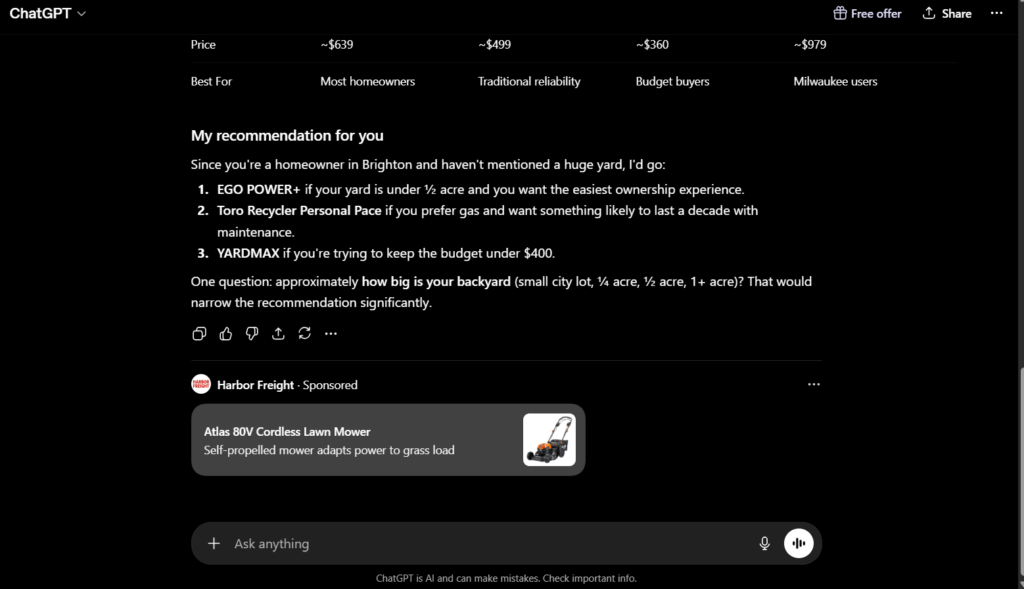
When someone asks ChatGPT a question, like “what’s a good accounting software for small businesses,” a sponsored result can appear below the answer. It looks similar to a Google search ad: a business name, a short description, and a link.
OpenAI has been clear that the ads don’t change what ChatGPT actually says, and that user conversations stay private. The ads are labeled so people know they’re seeing a paid placement.
It’s Gotten Cheaper to Get In, But Cheaper Isn’t the Same as Worth It
When ChatGPT ads first launched, you needed a massive budget just to test them. That’s changed. As of May 2026, any business can sign up through OpenAI’s self-serve platform with no minimum spend.
So the door is open. But open doesn’t mean you should walk through it, at least not yet.
Here’s the Catch: You Can’t See What’s Triggering Your Ads
This is the part that doesn’t get talked about enough, and it matters a lot.
On Google Ads, you can see every single search term that caused your ad to show up. If your ad is appearing for searches that have nothing to do with your business, you can fix it. If certain searches are driving your best customers, you can lean into them. That kind of visibility is how you make smart decisions with your budget.
ChatGPT doesn’t give you that. Ads are matched to conversations based on what people are discussing, but advertisers have no window into those conversations. You can see how many people saw your ad and how many clicked it, and with proper setup, you can track what those visitors did on your website after clicking. What you can’t see is what they were actually talking about when your ad appeared, or why your ad was shown in that moment.
That’s a meaningful gap. Without knowing what’s triggering your ChatGPT ads, it’s very hard to improve them. You’re essentially trusting the platform to match your ads well, with no ability to verify whether it’s doing that or correct it when it isn’t.
For a small business where every dollar needs to be justified, that lack of control is a real problem.
Who Should Wait (And Who Might Consider Testing)
Small businesses typically run ads because they need results like calls, form fills, and booked appointments. ChatGPT advertising isn’t built for that yet. You can’t see what conversations are triggering your ads, which means you can’t control who you’re reaching or improve your targeting over time. For a budget that needs to work hard, that’s too much uncertainty.
The businesses best suited for this right now are larger brands that aren’t expecting immediate, trackable returns. Think national companies running campaigns to get their name in front of people, not to generate leads this week, but to build familiarity over time. For them, the lack of targeting transparency is an acceptable tradeoff at this stage.
If you’re a small or mid-sized business and you’re curious about testing it anyway, the honest advice is to treat it like an experiment with money you can afford to learn from, not a budget you’re counting on to bring in customers.
What You Can Do Right Now That Actually Helps
You don’t need to advertise on ChatGPT to show up there. Businesses that appear naturally in AI answers are already getting visibility for free. Here’s where to start:
- Make sure your website clearly explains what you do. AI platforms pull from on-site content to form answers, so clarity matters.
- Keep your Google Business Profile current. It’s still one of the strongest signals for local AI visibility.
- Create content that answers real questions your customers ask. FAQs, service pages, and blog posts all contribute.
- Look into Answer Engine Optimization (AEO). Where traditional SEO focuses on Google rankings, AEO focuses on how AI platforms like ChatGPT read and talk about your business, so when someone asks an AI for a recommendation in your industry, you’re part of the answer. Learn how AI is redefining SEO here.
Linden offers AEO as a managed service, so if you’d rather not figure it out yourself, we can handle it for you. It’s one of the most practical steps you can take right now to stay ahead of where search is heading.
The Bottom Line
ChatGPT ads are real and getting more accessible. But for small businesses, the lack of meaningful reporting makes it hard to justify the spend right now. We’ll keep watching as the platform develops and let you know when that changes.
Have questions about where your marketing budget makes the most sense? We’re always happy to talk it through. Set up a time to talk.
Update, July 8, 2026: OpenAI has started rolling out audience list targeting for ChatGPT Ads. Advertisers can now upload raw or hashed emails and phone numbers to use as filters for campaign targeting, a new “Audiences” option under the platform’s Tools section. This is a targeting improvement, not a reporting one. Advertisers still can’t see which conversations trigger their ads. The core limitation this post discusses stands, without conversation-level visibility, you can upload a list of who you want to reach, but you still can’t verify who you’re actually reaching or why. We’ll continue to monitor how this develops.